Tagged: galaxy

Monster black hole unleashes messy double ‘burp’

Researchers observed the supermassive black hole at the center of the galaxy SDSS J1354+1327 with the Chandra X-ray Telescope (pink) and Hubble Space Telescope, noticing evidence of two “burps” of high-energy particles emanating from the black hole. One (below the black hole) has spread further,...

Aliens might shoot lasers at black holes to travel the galaxy

An astronomer at Columbia University has a new guess about how hypothetical alien civilizations might be invisibly navigating our galaxy: Firing lasers at binary black holes (twin black holes that orbit each other). The idea is a futuristic upgrade of a technique NASA has used...

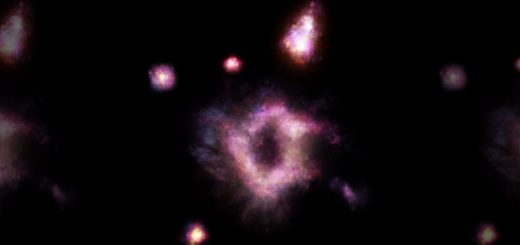
Ring of fire’ galaxy discovered 11B light-years from Earth

Researchers have discovered a galaxy roughly the size of our Milky Way that’s being described as a “cosmic ring of fire.” Known as R5519, the galaxy is 10.8 billion light-years from Earth. It’s also circular, similar in shape to a doughnut, the researchers noted in...

Does a planet need continents to support life?

Just in case you were feeling significant today, consider this: There could be 40 billion planets — all of them the size of Earth — orbiting sun-like stars in the Milky Way galaxy. And that doesn’t even include the other planetary possibilities that surely exist...

The Galaxy Just Got More Crowded

Today, a team of NASA scientists announced exciting news thanks to the Kepler telescope: the discovery of 1,284 new exoplanets. That’s the largest number of planets announced at one time. In fact, before the announcement, NASA had verified only 984 exoplanets in our galaxy. So...

Why Galaxies Come in Different Shapes

This image, taken with NASA’s Hubble Space Telescope, shows fresh star birth in the ancient elliptical galaxy NGC 4150, located about 44 million light-years away from Earth. NASA AND THE HUBBLE HERITAGE TEAM Hanging on the walls in countless science classrooms around the world are...

This Galaxy Doesn’t Have Dark Matter, and That’s Weird

This picture shows NGC1052 (on left), a massive elliptical galaxy that dominates the neighborhood where NGC1052-DF2 also lives. NGC1052-DF2 is an ultra-diffuse galaxy located 65 million light-years away that seems to be missing its dark matter. Also pictured are NGC1042 (the main spiral) and NGC1048...

Hungry ‘Hot DOG’ Eats Nearby Galaxies, Fattens Its Black Hole

An artist’s impression of W2246-0526, the most luminous galaxy ever discovered and one with an incredibly hearty appetite. (NRAO/AUI/NSF) S. DAGNELLO Galaxies in the farthest-most reaches of our universe are the epitome of extreme. Take W2246-0526. It may be smaller than our galaxy, but it...

Translate »