Category: News

Juno maps water ice across northern Ganymede

Jupiter’s moon Ganymede is the largest planetary satellite in the solar system. It’s also one of the most intriguing: Ganymede is the only moon with its own magnetic field, it is the most differentiated of all moons, and it likely possesses a subsurface ocean of...

Astronomers discover first cloudless, Jupiter-like planet

Astronomers at the Center for Astrophysics | Harvard & Smithsonian have detected the first Jupiter-like planet without clouds or haze in its observable atmosphere. The findings were published this month in the Astrophysical Journal Letters. Named WASP-62b, the gas giant was first detected in 2012...

OSIRIS-REx mission plans for May asteroid departure

Since its launch in September 2016, the OSIRIS-REx spacecraft has traveled billions of miles, mapped the surface of an asteroid in unprecedented detail, and made new scientific discoveries about near-Earth asteroids. Now, it’s preparing to bring a piece of asteroid Bennu home. On May 10,...

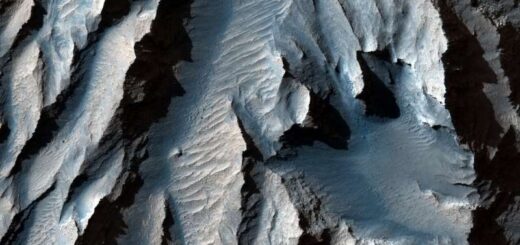
The obliquity of Mars: Periodic bedding in Tithonium Chasma

Earth’s seasons are caused by the tilt of our planet’s rotational axis to the orbital plane or obliquity. Mars’ obliquity is currently about 25 degrees, which is not much different from Earth’s 23 degrees. However, numerical calculations by scientists at the Paris Observatory and Massachusetts...

Best region for life on Mars was far below surface

The most habitable region for life on Mars would have been up to several miles below its surface, likely due to subsurface melting of thick ice sheets fueled by geothermal heat, a Rutgers-led study concludes. The study, published in the journal Science Advances, may help...

A warp in the Milky Way linked to galactic collision

When most of us picture the shape of the Milky Way, the galaxy that contains our own sun and hundreds of billions of other stars, we think of a central mass surrounded by a flat disc of stars that spiral around it. However, astronomers know...

Astronomers uncover mysterious origins of ‘super-Earths’

Mini-Neptunes and super-Earths up to four times the size of our own are the most common exoplanets orbiting stars beyond our solar system. Until now, super-Earths were thought to be the rocky cores of mini-Neptunes whose gassy atmospheres were blown away. In a new study...

UAE’s ‘Hope’ probe sends home first image of Mars

The UAE’s “Hope” probe sent back its first image of Mars, the national space agency said Sunday, days after the spacecraft successfully entered the Red Planet’s orbit. The picture “captured the largest volcano in the solar system, Olympus Mons, emerging into the early morning sunlight,”...

Translate »