Category: News

Imaging space debris in high resolution

Litter is not only a problem on Earth. According to NASA, there are currently millions of pieces of space junk in the range of altitudes from 200 to 2,000 kilometers above the Earth’s surface, which is known as low Earth orbit (LEO). Most of the...

An astronaut’s guide to out-of-Earth manufacturing

mprovising new stuff from the stuff you have is part of an astronaut’s job description—think Apollo 13’s crew refitting CO2 filters to save their own lives, or stranded Mark Watney in The Martian, feeding himself on the Red Planet. Now plans are underway to manufacture...

Five ways artificial intelligence can help space exploration

Artificial intelligence has been making waves in recent years, enabling us to solve problems faster than traditional computing could ever allow. Recently, for example, Google’s artificial intelligence subsidiary DeepMind developed AlphaFold2, a program which solved the protein-folding problem. This is a problem which has had...

Spacewalkers complete 4 years of power upgrades for station (Update)

A pair of spacewalking astronauts completed a four-year effort to modernize the International Space Station’s power grid on Monday, installing one last battery. Over the weekend, flight controllers in Houston used the space station’s big robot arm to replace the last pair of old-style batteries...

NASA’s Psyche mission moves forward, passing key milestone

Now just a year and a half from launch, the mission to explore a metal-rich asteroid will soon begin assembling and testing the spacecraft. NASA’s Psyche mission has passed a critical milestone that moves it a step closer to launch. After an intense review of...

Astronomers detect new super-Earth exoplanet orbiting nearby star

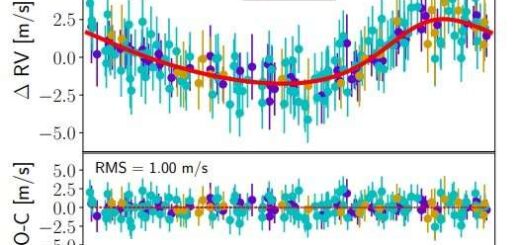
Using the radial velocity (RV) technique, astronomers have discovered a new super-Earth alien world as part of the HADES and CARMENES programs. The newfound exoplanet, designated GJ 740 b, orbits a bright star some 36 light-years away and is at least three times more massive...

Cold dust cores in the central zone of the Milky Way

The Milky Way’s central molecular zone (CMZ) spans the innermost 1600 light-years of the galaxy (for comparison, the Sun is 26,600 light-years away from the galactic center) and includes a vast complex of molecular clouds containing about sixty million solar-masses of molecular gas. The gas...

Ultramassive black hole in NGC 1600 investigated in detail

Using NASA’s Chandra X-ray observatory, astronomers from the University of Alabama in Huntsville have investigated the central region of the galaxy NGC 1600, focusing on its ultramassive black hole (UMBH). Results of the study, presented in a paper published February 11 on the arXiv pre-print...

Researchers investigate the brightest cluster galaxy in MACS 1931.8-2635

Using Very Large Telescope (VLT) and Atacama Large Millimeter/submillimeter Array (ALMA), researchers from the University of Vienna, Austria, and elsewhere have investigated the brightest cluster galaxy (BCG) in a massive galaxy cluster known as MACS 1931.8-2635. Results of the study, published January 28 on arXiv.org,...

Translate »