Tagged: Mars

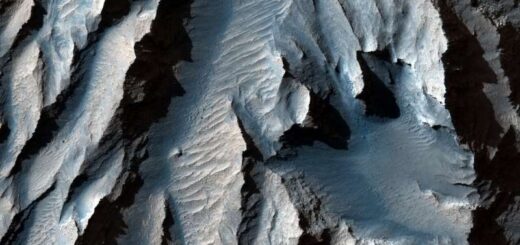
The obliquity of Mars: Periodic bedding in Tithonium Chasma

Earth’s seasons are caused by the tilt of our planet’s rotational axis to the orbital plane or obliquity. Mars’ obliquity is currently about 25 degrees, which is not much different from Earth’s 23 degrees. However, numerical calculations by scientists at the Paris Observatory and Massachusetts...

Best region for life on Mars was far below surface

The most habitable region for life on Mars would have been up to several miles below its surface, likely due to subsurface melting of thick ice sheets fueled by geothermal heat, a Rutgers-led study concludes. The study, published in the journal Science Advances, may help...

UAE’s ‘Hope’ probe sends home first image of Mars

The UAE’s “Hope” probe sent back its first image of Mars, the national space agency said Sunday, days after the spacecraft successfully entered the Red Planet’s orbit. The picture “captured the largest volcano in the solar system, Olympus Mons, emerging into the early morning sunlight,”...

Scientist proposes a new timeline for Mars terrains

A Southwest Research Institute scientist has updated Mars chronology models to find that terrains shaped by ancient water activity on the planet’s surface may be hundreds of millions of years older than previously thought. This new chronology for Mars, based on the latest dynamical models...

Every challenge astronauts will face on a flight to Mars

In 1972, the space race officially ended as NASA sent one last crew of astronauts to the surface of the moon (Apollo 17). This was the brass ring that both the US and the Soviets were reaching for, the “moonshot” that would determine who had...

The search for life beyond Earth

Mars may now be considered a barren, icy desert but did Earth’s nearest neighbour once harbour life? It is a question that has preoccupied scientists for centuries and fired up sci-fi imaginings. After seven months in space, NASA’s Perseverance rover is due to land on...

Early Mars climate was intermittently warm

A new study that characterizes the climate of Mars over the planet’s lifetime reveals that in its earliest history it was periodically warmed due to the input of greenhouse gases derived from volcanism and meteorites, yet remained relatively cold in the intervening periods, thus providing...

Translate »