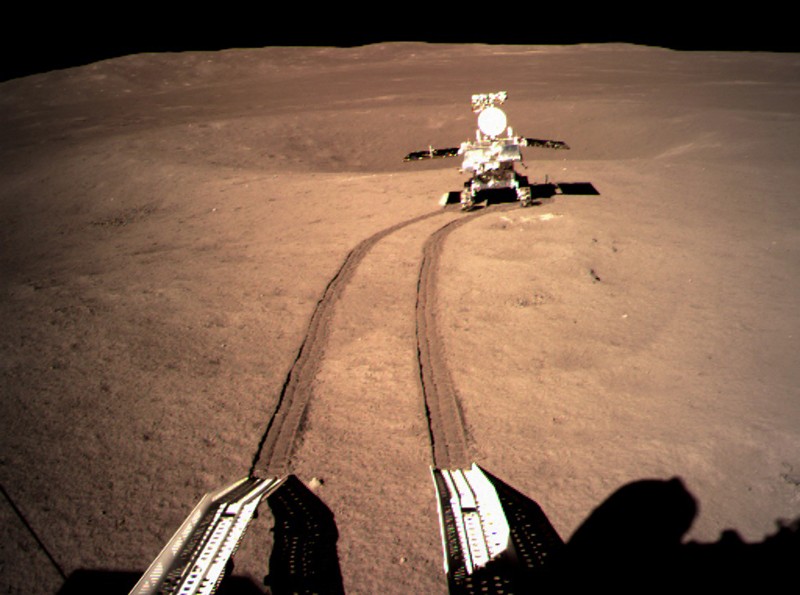
China’s lunar rover, Yutu-2, on the far side of the Moon.Credit: CNSA/Xinhua/ZUMA
China’s Chang’e-4 mission to the far side of the Moon has detected minerals thought to have been excavated from deep beneath the lunar surface by an ancient asteroid.
The spacecraft landed in the Von Kármán crater in the South Pole-Aitken basin in January, marking the first time a probe has ever visited the Moon’s far side. In its first investigations, the mission’s Yutu-2 rover used a visible and near-infrared spectrometer to analyse the light reflected off the crater’s surface.
Characteristic absorption patterns in the light, described in a paper in Nature today1, suggest the presence of the dense minerals olivine and low-calcium pyroxene, which are unlike any samples returned by previous probes and might originate from the lunar mantle.
The findings lend weight to the theory that the Moon’s surface was once molten but separated into layers as it solidified, leaving largely lighter minerals in the surface crust and burying denser ones in its mantle.


 Creators of mankind
 Description of “Tall white aliens”
 Where they came from?
 About hostile civilizations
 The war for the Earth
 “Tall white aliens” about eternal life
 Video: “Nordic aliens”
 Aliens
 Alien encounters
 The aliens base
 UFO
 Technology UFO
 Underground civilization
 Ancient alien artifacts
 Military and UFO
 Mysteries and hypotheses
 Scientific facts