Category: News

Blue Origin will fly first crew to space in July

Jeff Bezos’ Blue Origin will send its first crew to space on July 20 and is offering one of the seats to the winner of an online auction, the company said Wednesday. The trip will last a total of ten minutes, four of which passengers...

Machine learning accelerates cosmological simulations

A universe evolves over billions upon billions of years, but researchers have developed a way to create a complex simulated universe in less than a day. The technique, published in this week’s Proceedings of the National Academy of Sciences, brings together machine learning, high-performance computing...

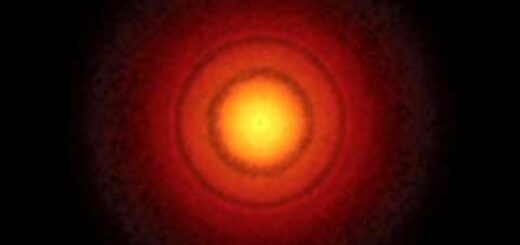
Planet formation may start earlier than previously thought

On their long journey to form planets, dust grains may coalesce with each other much earlier than previously thought, simulations by RIKEN astrophysicists suggest1. This may mean revisiting conventional theories of planet formation. Massive planets start off life as specks of dust that are too...

Image: OSIRIS-REx bids farewell to Asteroid Bennu

On April 9, 2021, NASA’s Origins, Spectral Interpretation, Resource Identification, Security, Regolith Explorer (OSIRIS-REx) spacecraft took one last look at Bennu, the asteroid from which it scooped up a sample last October. Slated for return to Earth in 2023, the mission is on track to...

Crashing Chinese rocket highlights growing dangers of space debris

This weekend, a Chinese rocket booster, weighing nearly 23 tons, came rushing back to Earth after spending more than a week in space—the result of what some critics, including NASA Administrator Bill Nelson, have attributed to poor planning by China. Pieces of the rocket, dubbed...

Solar Orbiter images first coronal mass ejections

The Solar Orbiter launched on 10 February 2020 and is currently in cruise phase ahead of the main science mission, which begins November this year. While the four in situ instruments have been on for much of the time since launch, collecting science data on...

Dark Energy Spectroscopic Instrument (DESI) starts 5-year survey

A five-year quest to map the universe and unravel the mysteries of “dark energy” is beginning officially today, May 17, at Kitt Peak National Observatory near Tucson, Arizona. To complete its quest, the Dark Energy Spectroscopic Instrument (DESI) will capture and study the light from...

Translate »