Category: News

eROSITA witnesses the awakening of massive black holes

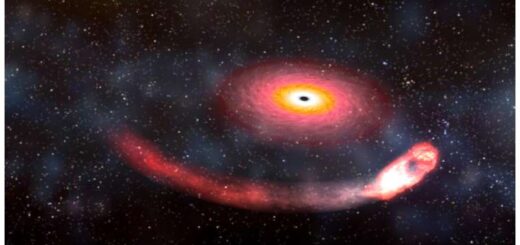
Using the SRG/eROSITA all-sky survey data, scientists at the Max Planck Institute for Extraterrestrial Physics have found two previously quiescent galaxies that now show quasi-periodic eruptions. The nuclei of these galaxies light up in X-rays every few hours, reaching peak luminosities comparable to that of...

Not all theories can explain the black hole M87

As first pointed out by the German astronomer Karl Schwarzschild, black holes bend space-time to an extreme degree due to their extraordinary concentration of mass, and heat up the matter in their vicinity so that it begins to glow. New Zealand physicist Roy Kerr showed...

Candid cosmos: eROSITA cameras set benchmark for astronomical imaging

Recently, the eROSITA (extended Roentgen Survey with an Imaging Telescope Array) X-ray telescope, an instrument developed by a team of scientists at Max-Planck-Institut für Extraterrestrische Physik (MPE), has gained attention among astronomers. The instrument performs an all-sky survey in the X-ray energy band of 0.2-8...

A solution to space junk: Satellites made of mushrooms?

According to the latest numbers from the ESA’s Space Debris Office (SDO), there are roughly 6,900 artificial satellites in orbit. The situation is going to become exponentially crowded in the coming years, thanks to the many telecommunications, internet, and small satellites that are expected to...

Finding quasars: Rare extragalactic objects are now easier to spot

Astrophysicists from the University of Bath have developed a new method for pinpointing the whereabouts of extremely rare extragalactic objects. They hope their technique for finding ‘changing-look quasars’ will take scientists one step closer to unraveling one of greatest mysteries of the universe—how supermassive black...

Translate »