Category: News

Cosmic Ray Originated In Cataclysmic Event

Cosmic rays are high-energy particles that travel through space at close to the speed of light. Many origins of cosmic rays have been suggested, and some confirmed; for example, supernova explosions generate them. But supernovae can’t explain the quantity of cosmic rays bombarding Earth at...

What Is A Quasar?

The word quasar stands for quasi-stellar radio source. Quasars got that name because they looked starlike when astronomers first began to notice them in the late 1950s and early 60s. But quasars aren’t stars. They’re now known as young galaxies, located at vast distances from...

Astronomers Spy A Nearby, Blazing Hot Super-Earth

Super-Earth exoplanets are defined as being larger and more massive than Earth, but smaller and less massive than Neptune (about 17 times Earth’s mass). Some super-Earths orbit near their stars and are likely too hot for life. Others orbit farther out and so would be...

A Hypergiant Star’s Mysterious Dimming

VY Canis Majoris – in the direction to our constellation Canis Major the Greater Dog – is one of the largest stars known. It’s a red hypergiant, so huge that it makes the famous giant star Betelgeuse look small by comparison. If you replaced our...

Do Mars Dust Storms Cause The Mysterious Zodiacal Light?

From Northern Hemisphere locations, in the weeks and months around the equinox, you can look west each evening after true darkness falls toward a mysterious hazy pyramid of light. It’s called the zodiacal light, and you can see it from the Southern Hemisphere, too; from...

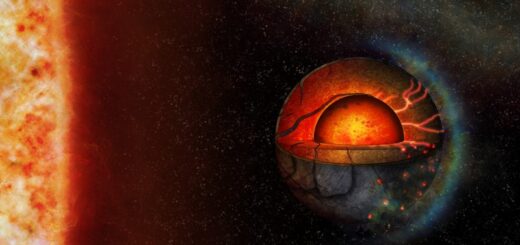
First Exoplanet With Evidence Of Tectonics

For the first time, scientists have found evidence of global tectonic activity – the movement of plates of a planet’s crust that happens due to heat inside the planet – on a world beyond our solar system. The new study, published February 24, 2021, in...

A Martian Cloud Reveals Its Secrets

Scientists announced on March 9, 2021, that they’ve unraveled the mystery of what creates a regularly occurring, long, thin cloud seen to stream away from the now-extinct Martian volcano named Arsia Mons. The cloud formation – which occurs seasonally – appears to be produced by...

Highest-Energy Cosmic Rays Originate In Star Clusters, Not Supernovae

Astronomers have long assumed that supernova explosions are responsible for cosmic rays – which are high-energy particles – zipping through space at the speed of light and regularly bombarding Earth from various directions in the galaxy. But supernovae can’t explain cosmic rays with the highest...

Translate »