Category: News

European Robotic Arm ready for space

The European Robotic Arm (ERA) will be launched to the International Space Station together with the Russian Multipurpose Laboratory Module, called ‘Nauka’. ERA is the first robot able to ‘walk’ around the Russian segment of the Space Station. It has the ability to anchor itself...

Russia to launch new International Space Station module

The long-delayed Russian module for the International Space Station is set to be finally launched this month, but the date has been pushed back several days, the head of the country’s space corporation said Thursday. Roscosmos director Dmitry Rogozin said on Twitter that the Nauka...

New radio receiver opens wider window to radio universe

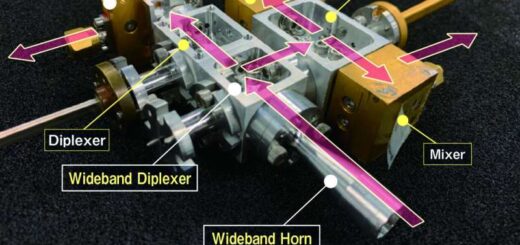
Researchers have used the latest wireless technology to develop a new radio receiver for astronomy. The receiver is capable of capturing radio waves at frequencies over a range several times wider than conventional ones, and can detect radio waves emitted by many types of molecules...

Scientists solve 40-year mystery over Jupiter’s X-ray aurora

A research team co-led by UCL has solved a decades-old mystery as to how Jupiter produces a spectacular burst of X-rays every few minutes. The X-rays are part of Jupiter’s aurora—bursts of visible and invisible light that occur when charged particles interact with the planet’s...

Image: Hubble glimpses a galactic duo

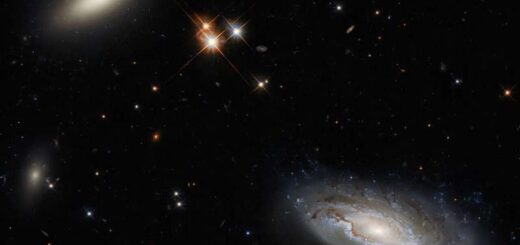
Two enormous galaxies capture your attention in this spectacular image taken with the NASA/ESA Hubble Space Telescope using the Wide Field Camera 3 (WFC3). The galaxy on the left is a lenticular galaxy, named 2MASX J03193743+4137580. The side-on spiral galaxy on the right is more...

First measurement of isotopes in atmosphere of exoplanet

An international team of astronomers have become the first in the world to detect isotopes in the atmosphere of an exoplanet. It concerns different forms of carbon in the gaseous giant planet TYC 8998-760-1 b at a distance of 300 light years in the constellation...

Translate »