Cosmic crash captured by Hubble triggers intense star formation
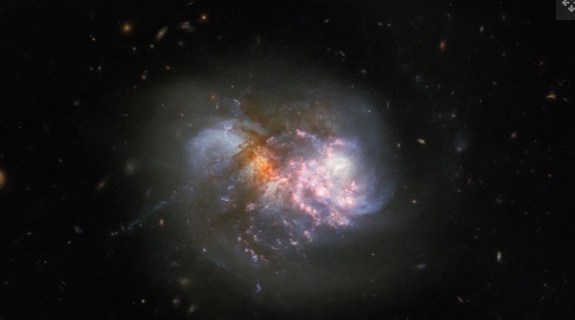
Two galaxies colliding 275 million light years away from the sun have been captured by the Hubble Space Telescope in a new image revealing signs of intense star formation about to happen. Astronomers use a single name for the pair of galaxies, IC 1623, as they are in the advanced stages of merging into one new “starburst” galaxy. The process is accompanied by a powerful inflow of gas that is triggering intense formation of new stars, hence the name “starburst”.
The merging galaxies are a part of the constellation Cetus (or Whale), the fourth largest constellation in the sky, which is located in the southern hemisphere close to Aquarius, Pisces and Taurus.
The image, taken by Hubble’s Wide Field Camera 3, combines observations in eight different wavelengths ranging from infrared to ultraviolet. ESA said in a statement the object will be among the targets of the NASA/ESA/CASA James Webb Space Telescope as astronomers seek to gain more insight into the processes powering extreme star formation. — Tereza Pultarova
 Creators of mankind
 Description of “Tall white aliens”
 Where they came from?
 About hostile civilizations
 The war for the Earth
 “Tall white aliens” about eternal life
 Video: “Nordic aliens”
 Aliens
 Alien encounters
 The aliens base
 UFO
UFO Technology UFO
 Underground civilization
 Ancient alien artifacts
 Military and UFO
 Mysteries and hypotheses
 Scientific facts