Tiny organisms turn the Black Sea turquoise in amazing NASA picture
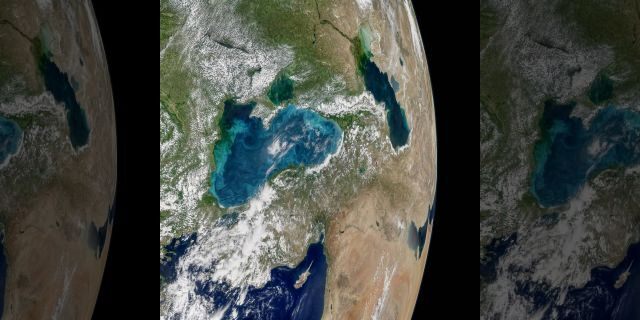
Turquoise swirls in the Black Sea — caused by phytoplankton carried on local water currents — shine brightly in a new image from NASA’s Aqua satellite.
Phytoplankton are tiny organisms that feed on sunlight and dissolved nutrients. The image shows the rivers Danube and Dnieper bringing these nutrients out to the Black Sea, where the phytoplankton feed on them, NASA officials said in a statement. In turn, these small organisms are eaten by larger animals such as fish and shellfish. [Earth from Space: More Amazing Photos]
In the Black Sea in particular, a type of phytoplankton community called coccolithophores are visible from afar because of the white calcium carbonate plates that shield their bodies, the statement said. The white is easily visible from space and appears like milk in the water. Diatoms, on the other hand — another type of phytoplankton found in the Black Sea — can make the water look somewhat darker.
In the statement, NASA said the reflectivity from phytoplankton in the Black Sea appears consistent with that of previous years. If the phytoplankton blooms are too large, this can lead to eutrophication, when oxygen is lost from the water and kills marine life.

 Creators of mankind
 Description of “Tall white aliens”
 Where they came from?
 About hostile civilizations
 The war for the Earth
 “Tall white aliens” about eternal life
 Video: “Nordic aliens”
 Aliens
 Alien encounters
 The aliens base
 UFO
UFO Technology UFO
 Underground civilization
 Ancient alien artifacts
 Military and UFO
 Mysteries and hypotheses
 Scientific facts