Stunning Hubble image captures monster star ‘doing something weird’
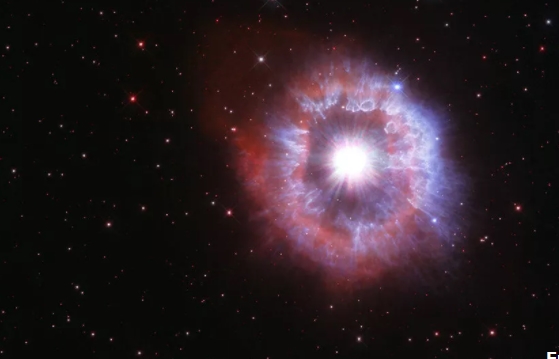
For its 31st anniversary, NASA and ESA’s famous space telescope captured a view of a star surrounded by a nebula.
The Hubble Space Telescope is a scientific marvel, still plugging away after 31 years. To celebrate its space birthday, NASA and the European Space Agency released a celebratory image on Friday showing one of the brightest stars in our galaxy, the ethereal AG Carinae.
NASA describes AG Carinae as a “celebrity star.” It’s not just a twinkling dot of light. There’s a lot of drama surrounding AG Carinae. It has a glowing gas-and-dust nebula that started forming around 10,000 years ago through an eruptive process, kind of like a stellar temper tantrum.
“These outbursts are the typical life of a rare breed of star called a luminous blue variable, a brief convulsive phase in the short life of an ultra-bright, glamorous star that lives fast and dies young,” NASA said.
Hubble launched on April 24, 1990. NASA and ESA originally hoped Hubble would last for at least 15 years of gazing out into the cosmos and capturing images of the universe around us. The telescope has survived technical issues (including a recent software error) and has managed to hold on, plugging away at its work for over three decades.
The anniversary image of AG Carinae seems fitting. The star has an outsized personality, especially compared with our sun. Scientists estimate it’s up to 70 times more massive and would take 1 million of our suns to equal its brightness.
There’s a price to be paid for AG Carinae’s brilliance. It’s expected to have a much shorter lifespan than a star like the sun. It’s unstable. But as seen by Hubble, it’s also beautiful.
 Creators of mankind
 Description of “Tall white aliens”
 Where they came from?
 About hostile civilizations
 The war for the Earth
 “Tall white aliens” about eternal life
 Video: “Nordic aliens”
 Aliens
 Alien encounters
 The aliens base
 UFO
UFO Technology UFO
 Underground civilization
 Ancient alien artifacts
 Military and UFO
 Mysteries and hypotheses
 Scientific facts