Researchers propose new method for absolute calibration of multi-mode satellite navigation receiver delay
Researchers from the National Time Service Center (NTSC) of the Chinese Academy of Sciences have proposed a new method to realize absolute calibration of multi-mode satellite navigation receiver delay.
The new method can be applied to fields like navigation positioning, satellite timing, and time transfer, increasing user positioning and timing accuracy.
The calibration of global navigation satellite system (GNSS) receiver delay poses a technology difficulty in the field of satellite navigation. The widely used relative calibration method can only obtain the delay difference between a tested receiver and a reference receiver.
However, fields like GNSS time offset monitoring, satellite timing technology and satellite-ground time synchronization need absolute calibration.
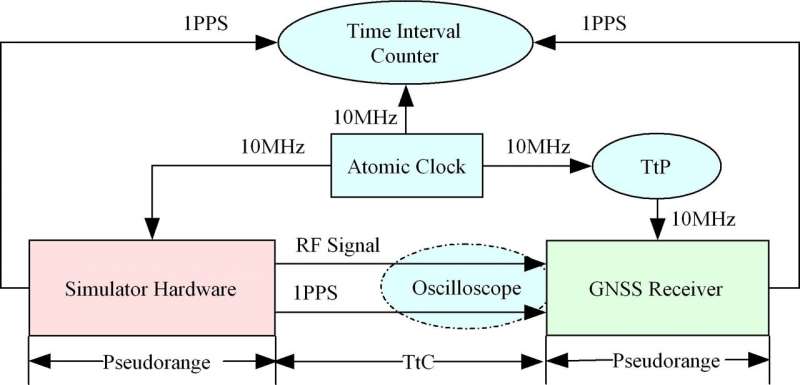
NTSC researchers used satellite simulator hardware and high-speed oscilloscope to completely calibrate all kinds of GNSS receiver delay, with the calibration accuracy better than 1.5ns(1σ).
An atomic clock provided reference frequency for all equipment. Testing Time-to-Code (TtC) by the oscilloscope was used to calibrate the simulator delay, and the channel delay could be calculated by the pseudorange, 1and PPS output delay measured by a time interval counter. The receiver delay maybe changed under different Time-to-Phase (TtP) by adjusting the phase of 10MHz reference.
The method can guide the users to calibrate the receiver delay of different navigation system, frequency band, pseudo-code signal and time-to-phase interface.

 Creators of mankind
 Description of “Tall white aliens”
 Where they came from?
 About hostile civilizations
 The war for the Earth
 “Tall white aliens” about eternal life
 Video: “Nordic aliens”
 Aliens
 Alien encounters
 The aliens base
 UFO
UFO Technology UFO
 Underground civilization
 Ancient alien artifacts
 Military and UFO
 Mysteries and hypotheses
 Scientific facts