How Lunar Liquid Mirror Telescopes Work
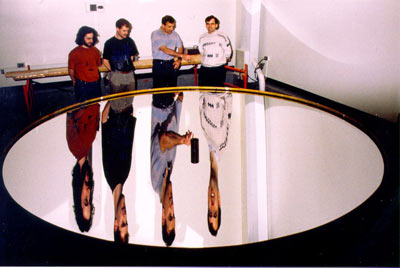
Since it was repaired in 1993, NASA’s Hubble Space Telescope has amazed scientists and citizens alike with its views of the universe, including glimpses of the farthest known galaxies. The mirror in Hubble, however, is relatively small at 94.5 inches (almost 8 feet) across, a limitation that has encouraged NASA to think bigger. The James Webb Space Telescope, slated for a 2013 launch, will boast a 20-foot mirror capable of providing seven times the light-collecting area of Hubble.
But NASA is also considering a more intriguing solution — a special type of reflecting telescope that uses a liquid, not glass, as the primary mirror. Known as a liquid mirror telescope (LMT), it wouldn’t view space from Earth’s orbit, as Hubble does. Instead, it would peer into the universe from the moon’s surface. The telescope would be anywhere from 66 feet to 328 feet wide, making it the largest telescope known to man. It would collect 1,736 times more light than Hubble and penetrate the depths of the universe to see objects nearly as old as the Big Bang.
This article will explain how a liquid mirror telescope works. It will look at the structure and function of an LMT, but it will do so in light of a moon-based deployment. How in the world does one build a telescope on the moon? How difficult is it going to be to build an LMT on the moon? And most importantly, what opportunities can a lunar telescope provide?

 Creators of mankind
 Description of “Tall white aliens”
 Where they came from?
 About hostile civilizations
 The war for the Earth
 “Tall white aliens” about eternal life
 Video: “Nordic aliens”
 Aliens
 Alien encounters
 The aliens base
 UFO
UFO Technology UFO
 Underground civilization
 Ancient alien artifacts
 Military and UFO
 Mysteries and hypotheses
 Scientific facts